Translate

Friday, 24 June 2016

Buddha Eden


 A sad day to be British - we went to bed on our lovely rural Spanish campsite as Europeans and woke up as Brits.  And yes, we voted to stay in Europe - organised proxy votes before we left.  Feel close to tears as I post this . . .

Note - we are about two weeks behind with the posts:

We were ambitious enough to hope to be able to reach Buddha Eden, near Óbidos the same afternoon, aided by a Google map tile downloaded the previous day.  This, it transpired was the best (and sometimes only) way to navigate the Portuguese non motorway road network as our map, an up-to-date Michelin, was sadly inadequate, a problem encountered by other travellers we spoke with, who had the same issues with their new AA map.  Further investigation revealed a country in which a third of the land is of unknown ownership, which may help explain our difficulties a little.


We arrived at the Buddha Eden park around 2pm, with four hours ahead of us to explore this fabulous tribute to the destroyed Buddhas of Bamiyan in Afghanistan, blown up by the Taliban in 2001.  The park consists of replica buddhas and a terracotta army (painted cobalt blue) alongside more modern sculptures and works of art from Europe and Africa, all set in marvellous parkland with lakes and ponds.


The park is the brainchild of a local wine producer, Bacalhóa, who funded and created the park.  For just €3 entry, you can happily while away the hours wandering past lakes, buddhas and modern art installations, through an African jungle populated by wonderful sculptures of men, women and beasts.


The hours flew by and by closing time we had just about walked the entire park but were left feeling that we could have happily spent an entire day.  Lunch here is also very good we’ve heard.  Even the pathway to the exit is beautiful, lined with tiled representations of the history of wine.


With our imaginations buzzing from all we’d seen, we exited through the gift shop, picking up four bottles of wine from the estate.

It had been a long day and we were tired, so we retired for a cuppa to a nearby picnic area or ‘parque de merenda’, Bom Jesus, that we’d passed on our way in.  Leafy eucalyptus sheltered us from the sun and the park was peaceful once the afternoon picnickers had gone, save for two amiable stray dogs who soon ambled off as well, and then it was just us, a small church, the twelve stations of the cross and a fabulous night’s sleep  . . . Even the chime of the church bells every 15 minutes didn’t wake us.


Next stop, somewhere on the beach!

J.

Tuesday, 21 June 2016

Sesimbra – a tale of tiles, graffiti and spectacles….


As we were planning our next steps north from the fabulous Troia peninsular, we mulled over having lunch in Setúbal (where we had feasted on an enormous platter of fried seafood with the kids 20+ years ago, or heading further west to the small town of Sesimbra, where we’d never been and which was famed for its seafood restaurants. So, bouyed by our success with dinner out in Cacela Velha, we pushed on to Sesimbra to explore the municipal site set on a hill overlooking the bay that it nestles in.

And what a find it was! For just under €12 we were treated to fine views through the tree-lined terraces on enormous pitches that would easily have fitted two camper vans and a tent to boot!


Situated next to an old Fortaleza and overlooking the port, the enthusiastic campsite staff told us it was a 25 minute walk to the centre if we wanted to eat out that evening – as the site restaurant (which itself had amazing views) might, or might not, be opening – ‘depende!’


As we had made good time (for Portugal) we decided to head off to the town to look around the sights in the late afternoon – after a by now customary coffee and pastele de nata. Our guidebook had outlined the key attractions as the old Fortaleza on the beach (once a summer home to the Portuguese royals); the many extravagantly tiled houses; and of course the seafood restaurants – which line both the promenade and the back streets.

The 17th century Fortaleza Santiago was suitably impressive with newly restored museums and a swanky terraced bar. Keen to spend time in the backstreets and the tiled houses, we stayed long enough for a couple of proper tourist pics and then headed into the town.


Sure enough, the town was peppered with amazing houses covered in intricate exterior tiling – adding both decoration and functional waterproofing!


It soon became clear though, that as well as the tiled houses, there was a strong (and more recent) tradition of street art that at times blended with the faded grandeur of the old tiled houses…


…and also stood in its own right on doorways, which seemed to be a popular form of expression:


And to add to Sesimbra’s charms, as we wandered further into the backstreets we came across a fabulous display of local school children’s crochet skills, set out in a lovely shaded square and adorning the trunks of trees – including the most amazingly pruned bouganvillias I’ve ever seen, that had been intertwined to proved a lovely shaded area.


And so the time came to choose which of the many restaurants would deliver up a seafood treat – one on the front with a view, or one in the less busy side streets. Expecting the Portuguese to follow what we had come to know as more northern European eating times, we were surprised to see that by 7.30 none of them seemed to have any punters – and instead most peeps were lazily drinking beers and eating their way through mounds of caracais (snails) in the many snack bars. Determined to treat ourselves to a proper seafood extravaganza in one of the many charcoal fuelled eateries, we opted to find somewhere that was serving dinner rather than snacks – which we eventually found overlooking the bay. Coinciding with our choice, the wind decided to pick up and blow a proper hooley – so we gave up on the view and went inside to join the other diners. Now, those of you who wear specs will appreciate this – to my horror, as I went to swap from my sunglasses (fine outside but useless indoors) and I opened my case to take out my normal specs – I discovered the box was empty! I’d clearly left my ordinary specs back at the van – so I was now faced with an evening as Stevie Wonder, or one of scowling my way partly-sighted through the menu! Luckily Mrs B stepped in as menu reader, wine pourer and general guide to the less able…

The food, after all the hype was a mixed bag. Mrs B wisely opted for fresh sardines cooked right in front of her on the BBQ. Less wisely, I opted for chocos (cuttlefish) and chips – one of my favourites. Unfortunately, our chosen restaurant had opted for the ‘trick the tourist’ version of carefully machined bits of ‘poton’ – giant squid that are so huge they are machine processed in sheets and served to unsuspecting eaters. Much less sweet and much more chewy, I nonetheless ate the lot after all the expectation – washed down with a fab bottle of local wine that eased the disappointment.

And so, aided by Mrs B taking my arm as she led me back up the hill to the campsite, we settled in for what promised to be another peaceful night under the Portuguese stars.
So, after some sleep and waking to yet another sunny day, we set off for our next stop – Buddha Eden!

S.


Wednesday, 15 June 2016

Sagres to Setúbal


We turned right at Vila do Bispo with a small sigh of relief, leaving mass tourism and high rise behind for a picturesque drive past Carrapteira and Odeceixe, wild and windy surf spots of past visits but not on the itinerary this year.

We stopped off at Miróbriga en route, a small but perfectly formed Roman site.

We arrived in Comporta a windy - and windy, four hours later to a brand new covered car parking area and a campervan ban for any more than 8 hours.  The wind was howling and surf was up but the beach here is still as beautiful as ever, in spite of the serried ranks of parasols that seem to have replaced the colourful fishing boats, but the two restaurants we remember are still here, with a small cocktail bar addition selling trendy cocktails, and the feel has changed from undiscovered to smart hippy surf vibe.

It was interesting to see but not an option to stop, so we backtracked south, passing the inland village of Comporta with its storks’ nests, looking not so very different from its 1990s self.


Then past Carvahal (same parasols and car park) and decided to take a chance on a dead end road to a campsite, signed from the main road - and were very glad we did!

Camping Galé is an old school style campsite, just north of Fontainhas, with an impressive show of security (think combat trousers, truncheon, handcuffs and mace spray!) set in the pinewoods above one of the most spectacular beaches we have seen in a long time.  The site is home to mostly 'permanents'; caravans and cabins used by weekenders from the city and also a tented surf school – maybe the security is for potentially unruly young folk? Although the international surf school community seemed perfectly behaved to us.


Parking for campervans and caravans is restricted to a small area near the beach, and tents further up the hill.  Security aside, the whole place has a very relaxed feel and is nicely self-contained with a supermarket and even a fresh fish shop.


Day one - lounge on the beach, eat barbecued besugo (rose grey bream), get tipsy.  Day two, lounge on the beach, eat barbecued frango (that's chicken to you!) and drink lemon squash - ready for the drive to Setúbal the next day.  We felt very blessed to have enjoyed two fabulous beach days here and vowed to go ‘off ACSI’ again if we thought the destination looked good.  It’s very easy to get into a rhythm of hopping from one safety net to the next and probably means missing out on some of the more interesting options.


The drive to the ferry was an easy hop and we were soon on board and across the estuary from the Troía peninsula to Setúbal.   


We’d decided to go straight from there to Seisimbra, a short and as it turned out, very scenic hop along the coast through the Arrábida national park.
J.

Sunday, 12 June 2016

Transit to Portugal – the Algarve


After a week of free camping and staying on a great camperstop near Sanlúcar, we decided to head off to Portugal a day earlier than we’d planned. The regular strong winds had brought forward our desire to seek a bit of campsite civilisation on the Algarve – where we had lots of fond memories of touring in our two previous campers over 20 years ago. So, with a mix of excitement and trepidation (given we had observed on our last visit how the Algarve had already sold its soul to mass tourism in the 60s) we set off to cross the border in search of a campsite on the beaches of the sun-kissed coastline.

The journey around the famous nature park at Doñana was fairly uneventful, as much of it is not really visible from the roads that define its boundaries. (It’s another place on our list for a visit in the future.) Skirting Sevilla we headed west to the border, reading up about Portugal’s new electronic toll motorway network that requires registration as you cross the border – and sure enough as soon as we crossed over from the free Spanish side, there were the signs for foreign vehicles to pull over and register. We, however, had decided to avoid the Portuguese toll roads in favour of the less busy back roads, so we sailed pass the signs for foreigners instead. It looked from the map that we should be able to do the last leg across the border for free, but it wasn’t until we actually turned off the motorway and saw there wasn’t a sneaky toll-booth waiting for us, that we heaved a sigh of relief!

The relief was short lived though, as we’d also read that since the new motorway network had been built, signs for the free roads were scarce, in order to encourage greater use of the toll roads. And sure enough, navigation required 100% concentration from both driver and map reader to avoid being shunted back onto the motorway!

Our first planned destination was Olháo, where Mrs B’s brother and family have spent many a happy holiday. With two campsites nearby, and tales of campervans free parking near the port, our hopes were high for a quick and easy first night’s stop. However, the campsites weren’t quite what we had in mind (think rammed/virtually full, and a good yomp from town and beach) and the free camperstop was bleak and full of ‘no camping’ signs and enforcement by the local Policia. So after a walk along the seafront admiring the amazing range of seafood restaurants, we fell back on plan B: to try a place we had free camped over 20 years ago with the kids, in the grounds of a ruined seafront ‘factory’.

Convinced that we were seriously tempting fate after all this time, we arrived in Fábrica near Cacela Velha to find that the old ruins had been replaced by an amazing and enormous walled villa ...


– but that the rest of this bit of coast was as we remembered it – including a very nice restaurant that was still there! So, after finding a nearby spot to camp up and after a brief walk along the sandy shore, we washed and changed into our gladrags to head off for dinner.


And what a dinner it was, overlooking the fabulous sand-spit we used to get the boat out to, with the sun setting and an amazing Cataplana de pescado (fish and shellfish stew) to share with a bottle of local rosado. After polishing off enough food for at least four people, we wandered back to the van for a peaceful first night’s sleep in Portugal.


The next day started with fabulous views across the shimmering sea – and an exploration of a new ‘cabin-café’ that had sprung up since we last visited. After a couple of Portuguese versions of our favourite Spanish coffee (cortado) and pasteles de nata (custard tarts) we were set for the drive and what we assumed to be the next stage of a simple quest – a decent campsite on the beach. Long story short, it didn’t happen. Although it’s pretty easy to free camp (as we had the previous night) the camperstops that have sprung up in imitation of the French ‘Aires’ have (so far) lacked any of the charm and interest of their French counterparts, and are more akin to barren car parks – and pretty busy to boot! They are fine if that’s what you want – but we were on a mission for a bit of comfort!

It seems from talking to a few people (including the very helpful owner of one of the campsites we turned away from) that large numbers of French camper vanners who normally over winter in Morocco have returned to Europe as a safe option – with the knock on effect that places are a lot busier – both camperstops and campsites.

Realising that we were unlikely to find what we were looking for in the Algarve, we opted instead for a close-but-no-cigar option of a decent site with a pool where we could just chill for a couple of days before heading north.

And so we landed in pimp-my-campsite ‘Yelloh! Village’ in Espiche near Lagos. Part of the German owned ‘Leading Campings’ group that operates posh campsites across Europe, we were treated to fabulous views north to the Monchique mountain range and luxy facilities – and all for our ACSI discounted rate of €17 a night! 


Again, this site is rammed – except for the bit we’re in – as our fab views (the other side of a hill) also mean we cop the prevailing wind which most of the other campers seem to want to shelter from. As I write this under a starlit sky and just a few other campers for company on the windy side of the site, I somehow think it’s their loss – especially as the wind does (sometimes) die down at night and the sunsets are gorgeous! 


We only intended to stay a couple of nights – but the luxy pool and cool vibe kept us for four!


So, batteries recharged (that’s me and Mrs B – the van has been just fine even after a week off grid!) our next stop is another trip down memory lane – Comporta near Setubal – fingers crossed!

S.

Thursday, 9 June 2016

Sanlúcar de Barremeida


We bowled into Sanlúcar in the early evening, ready to park up at the seafront camperstop in our Aires guide, only to be turned away by two friendly Guardia, telling us it was fiesta time and that our parking spot was currently occupied by a huge funfair!  They redirected us along the beach to a small parking area at the back of the dunes, where we joined a dozen or so other campers and marvelled at our luck.  This was a much nicer spot and still within walking distance of the town.  Aires like these often make for some interesting conversations and within the next hour or so we'd chatted to a young couple with baby in tow, away for 9 months, mixing freecamping with sites, and a couple our age who'd been shuttling back and forth between the free aire and another paid aire at La Jarra, where you could shower and get water and which wasn't in our guide, more on which later.

Tired after the drive, we had an early night and next morning were up bright and early (for us!) and striding along the prom to find the Turismo and check out the sherry tours; the primary reason for our visit here being to sample the locally produced Manzanilla.

The main paseo had been transformed with tents housing small bars and restaurants and everywhere, sherry on tap.  There were some fabulous frocks as well, with both men and women looking amazing. 


We arrived at the tourist info to find that we'd missed the tour at Barbadillo in English at 11am, but could try the one in Spanish at 1pm. No problem we thought, and headed off.  But we were off season and the tours only run with 8+ participants, so instead we did our own tour around the fascinating museum at the bodega, reading about how sherry is made and that it loves the peace and quiet to mature:  "all this rushing around is no good . . . " . We also had an interesting insight into the trade, as a couple of buyers were there, making arrangements to be collected from their hotel the next day. 

We left with a few bottles to sample, including a half bottle of Manzanilla recommended by an English buyer which isn't available in the UK, and strolled back through the side streets to the centre of town, but not before stopping off at a smaller bodega 'Caireles', where we were able to sample and buy some more delicious sherries, this time Oloroso as well as Manzanilla.

 
Then it was time for lunch in one on the bustling squares where we tried tortallita de camarones for the first time, fritters made of fresh shrimp, deep fried to a crispy deliciousness, and other fishy treats, all washed down with, you guessed it, Manzanilla from the barrel!

All around, tables were being taken as they were vacated, waiters bustling back and forth, never missing an order or new arrival.  We gave our table to these lovely folk . . .


Slightly tipsy we began to potter back to the camper, but not before we'd stumbled on yet another treat; a large tented area which was host to a traditional flamenco performance, guitar and vocals, and this couple were amazing, as were the audience, with women of all ages dancing and clapping in perfect time to the complex flamenco rhythm.


Refreshed by our afternoon cuppa back at the van, we headed back along the promenade, walking its whole length to the westering sun.  Silhouetted against the red sky, microlights buzzed above.


We turned into the town centre again, this time festooned with lights and noisy with chatter, and stopped for sherry and tapas, more shrimp fritters, octopus and prawns before heading back to base camp.


After two nights freecamping we thought we'd head off the three or four kilometres up the coast to La Jarra and the camperstop, since we needed water - and a shower!  There had been nowhere to discharge waste water at the freecamp, making it tricky to use our own.

It turned out that the aire was perfect, nicer than some campsites we've been on, with grassy pitches, ample hot water, a washing machine and a lovely owner, Alfonso, who was on site most of the time.  There was even free wi-fi! At €8 it was a bargain.  We whiled away a couple of days here, walking on the beach (esturial and tidal, so not really a swimming beach but pretty all the same) and the small local general store provided all we needed.


Feeling refreshed, we set off for the coastal drive past the Doñana natural park, to Portugal.


J.

Friday, 3 June 2016

Córdoba to Arcos de le Frontera


Andalucia continues to surprise us, as we head off towards the coast near Cádiz via some of the ‘must see,’ if clichéd, white towns of this part of Spain. We decided to see whether we could make up our own white town route to minimise the cliché effect, but we hadn’t even left the outskirts of Córdoba before we ran into one – almost literally as we stopped at a set of lights to let a group of immaculately turned out Andalus caballeros set the pace for the road out of town. The combination of impressively groomed horses, classic Andalus attire and the almost haughty one-handed riding style could have been straight out of a tourist board brochure. And that seems to be the thing about this province – lots of what might otherwise be just laid on for the tourists, does seem to be lived by many of the locals – perhaps I need to recalibrate my cynicism filter!


The first stop on our home-made itinerary was a hilltop town called Olvera, where we camped up at Camping Pueblo Blanco for the night. Although the pitches may have been in need of a bit of maintenance, they were huge, and afforded 360 degree views of the surrounding countryside.


The predominantly arable landscape (with a small amount of livestock) is dotted with ranges of big hills – and is not at all like the parched and dusty scrubland, which is our abiding memory of our times further south around Tarifa over 20 years ago. The large estates of the small number of wealthy landowners here are well maintained and lend an unexpected air of opulence to what is Spain’s poorest region (the workers of course, may have a different view….).


The visit to Olvera yielded some interesting insights. It’s on yet another via verde (cycle/hiking track) that was once a train route for the transportation of goods and materials across the sierra. For keen cyclists/hikers these routes offer some amazing sights through bits of the countryside that would otherwise be pretty inaccessible. The town also has a well maintained aire for campervans at €7 a night with electricity. It’s a very steep walk back into the town from there, so we parked (a lot!) closer.  2016 was some sort of anniversary year for Olvera and virtually every building had been painted in the customary super-bright white – making it very hard not to take photos every few metres! Even the one building we did find that was slightly dilapidated had a picturesque backdrop of the old (originally) Moorish castle on top of the hill.


The town itself is crowned by the castle and an imposing church, visible from miles around and linked to a series of watchtowers across the hills.


The castle has been renovated in the predominant style here – you can walk around it and see what it used to look like in Christian re-conquest times, with quite a lot of modern building ‘in the style of’ the period. As I’m no historian or archaeologist, I love this, as it takes no imagination at all to grasp what it would have been like at the time. Plus, it lends itself nicely to some proper tourist pics!


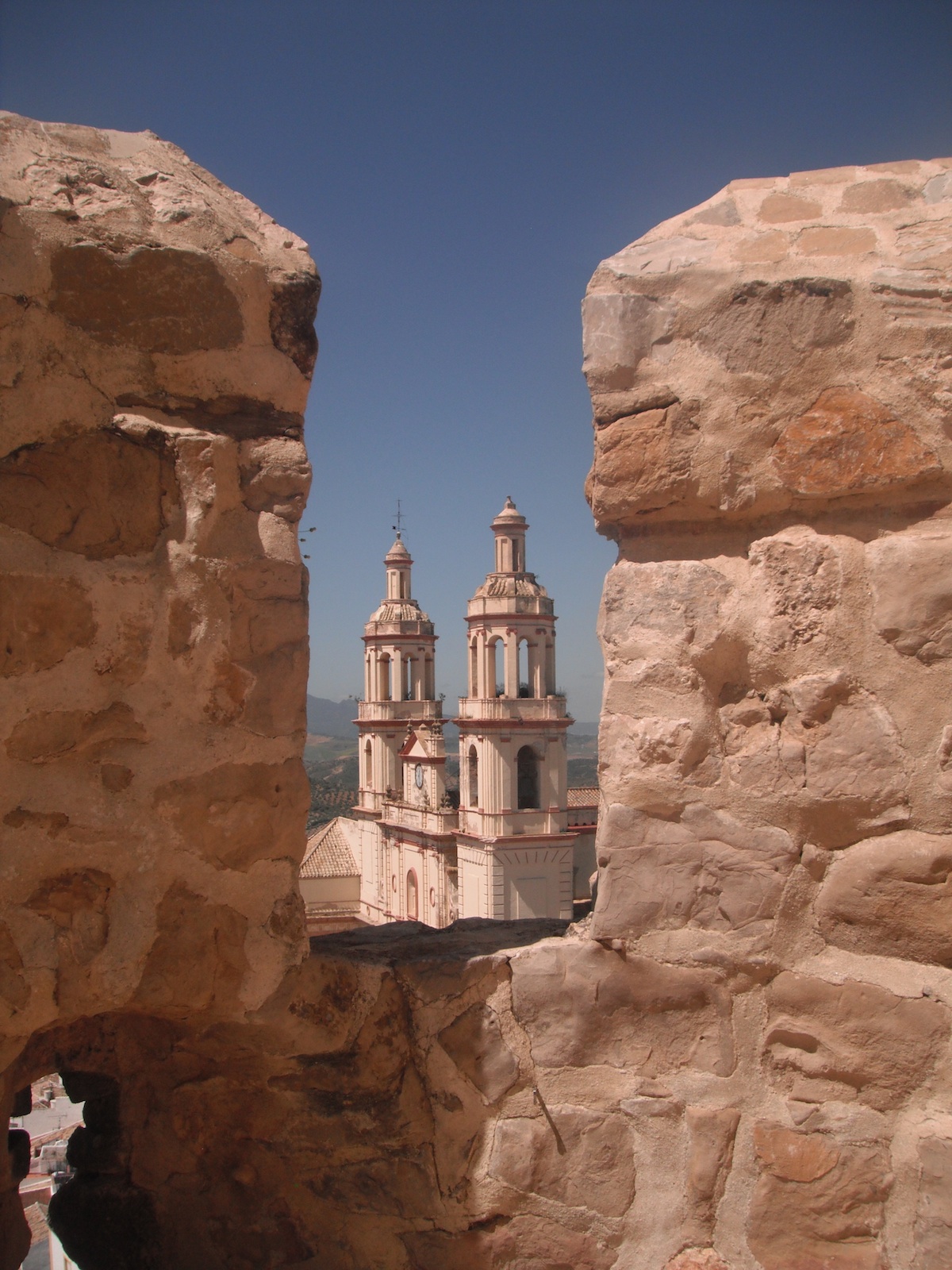
One of the best views of the church is from the top of the castle, where the immaculately presented frontage (visible from the town square and most of the rest of the town) gives onto a slightly tired but still impressively large building. Olvera may not be at the top of the ‘official’ white town route, but it has a charm and authenticity that make it a great place to stop and soak up the vibe – and at affordable prices too – our ‘tinto verano’, orange juice and plate of olives cost all of €2! But if you are taken by this little gem, don’t leave it too long – on our way out of town we spotted an English estate agents…


By way of contrast, Arcos de la Frontera, often described as ‘Ronda’s poorer relative’ was clearly more on the tourist route. We parked in the massive coach and car park outside the town (next to some canny French campervans that had spotted a working fresh water tap!) and walked in. Although it was quiet compared to say Córdoba or Granada, and the brolly-led coach parties were not in evidence; the bars, shops and restaurants were geared to that level and almost every lane we walked along had waiters trying to encourage us to stop.

Arcos is, none-the-less, a very pretty and photogenic hill top white town albeit with a slightly grander and more gothic feel to Olvera, and some views just had to be photographed.


However, we did choose not to photograph the half dozen sad looking owls and raptors that were available for a photo call at one of the miradors, where instead, Mrs B was snapped with her anti-fainting brolly.


So, was Arcos worth it? It’s a bigger town than Olvera and although poorer than Ronda, it’s on a much grander scale than Olvera, as can be seen by the size of some the town houses.


It is of course horses for courses though and I’m glad that we managed to squeeze two white towns into our drive to the coast for what will be one of the highlights of the trip for me: an homage to one of our favourite types of sherry – Manzanilla and Sanlúcar near Cádiz!

S.